
If Rome loved anything, it was a man who could fight and win. And if Rome loved two things, it was a man who could fight, win, and then write elegant commentaries about how brilliantly he did both. Enter Julius Caesar in Gaul.
While campaigning, he wrote the Commentarii de Bello Gallico (“Commentaries on the Gallic War”). These weren’t dusty military dispatches; they were polished, gripping accounts written in crisp third person:
“Caesar did this, Caesar did that.”
It gave him the air of detached historian, when in reality it was brilliant propaganda. Romans back home devoured the commentaries like binge-worthy scrolls. Caesar wasn’t just winning battles—he was shaping how those battles were remembered.
From 58 BCE to 50 BCE, Caesar fought in the lands we now call France, Belgium, Switzerland, and Germany. In nine relentless years of campaigning, he transformed himself from an ambitious politician drowning in debt into a conquering general with unstoppable momentum. These weren’t just wars—they were Caesar’s stage, his masterpiece, his nine-season epic before the Rubicon finale.
If Caesar’s early career was about clawing his way up the political ladder, and his Rubicon crossing was about defiance, then the Gallic Wars were his blockbuster season. Think of it as part brutal reality show, part political PR machine, and part military textbook that would be studied for centuries.
Why Gaul, Anyway?
Rome in the 50s BCE was a mess: political rivalries, street violence, and an economy straining under corruption. Caesar personally needed two things:
1. Glory, to match rivals like Pompey, whose victories in the East had made him the darling of the Senate.
2. Money, because Caesar’s political career had drained his personal fortune. Campaigning wasn’t just about patriotism—it was about loot, land, and political leverage.
Gaul was the perfect stage. Its tribes were divided, its lands fertile and rich, and its borders unstable. It wasn’t yet a nation but a patchwork of alliances and rivalries. For a man with vision and legions, it was a chessboard waiting to be rearranged.
Divide and Conquer
Caesar’s genius was not just his speed on the battlefield but his cunning in politics. The Gallic tribes were fierce, but they were not united. Caesar played them like pieces on a board: one day ally, the next day enemy, depending on Rome’s needs.
He marched astonishing distances, sometimes 25 miles a day, catching tribes by surprise. He built roads, bridges, and fortifications at a pace that stunned even his enemies. One winter, when most armies would have rested, Caesar crossed the Alps through snow and ice to confront the Helvetii, setting the tone for the entire campaign: Caesar never waited for trouble—he brought it.
The Brutality of Victory
The Gallic Wars were not clean. They were brutal and often merciless. By Caesar’s own count, over a million Gauls were killed or enslaved. Entire towns were destroyed. To Roman readers, these numbers meant glory and wealth; to the Gauls, it was cultural devastation.
Yet this brutality cemented Caesar’s reputation. His legions grew rich with spoils, their loyalty unshakable. His political enemies back in Rome couldn’t match the loyalty of soldiers who had followed Caesar through mud, hunger, and endless war—and emerged victorious.
By the end of the nine-year campaign, Caesar had:
Expanded Rome’s borders to the Atlantic.
Amassed wealth for himself and his men.
Forged a fanatically loyal army, more tied to him than to the Senate.
Secured his place among history’s greatest generals.
And crucially, he now had a power base outside Rome’s fragile politics. The Senate might fear him, but his soldiers adored him. When the time came to march across the Rubicon, they would not hesitate.
As Caesar himself wrote, cool as marble:
“Gallia est omnis divisa in partes tres.”
(“All Gaul is divided into three parts.”)
True enough. But by the time Caesar was finished, those three parts were united under one power: Rome—and one man: Caesar.
The Helvetii Migration: Caesar’s Opening Move(58 BCE)
The wars began with the Helvetii, a Celtic tribe from modern Switzerland. Pressured by neighbors, they decided to pack up—some 350,000 people, wagons, warriors, women, and children—and migrate westward through Roman territory. For Rome, this was like a caravan of hundreds of thousands showing up uninvited at your border with their wagons, cattle, and weapons. Caesar framed it as a defensive necessity: Rome had to stop them.For Caesar, this was the perfect excuse to play hero. He told Rome he was defending Italian allies, but in reality, he saw opportunity.
At Bibracte, Caesar showed off what would become his signature: speed, organization, and morale. His men were outnumbered, exhausted, and under pressure.
At the Battle of Bibracte, Caesar’s legions were caught in a desperate fight. The Helvetii pressed hard, and panic flickered through Roman ranks. But Caesar had a gift: he could see disorder and shape it into order in the blink of an eye. He galloped into the thick of combat, cloak flying, voice booming, steadying his men. Roman shields locked back into formation, pila (javelins) flew, and slowly the tide turned.
The Helvetii were crushed. Caesar then sent the survivors back to their homeland—to repopulate it and serve as a Roman buffer zone. Brutal, practical, and clever, the message was clear: Caesar had arrived.
Belgae in the North: Fire and Discipline(57 BCE)
In 57 BCE, Caesar turned his gaze north to the Belgae, tribes inhabiting modern Belgium. He flattered them as “the bravest of all the Gauls”—right before marching to conquer them.
The showdown came at the River Sabis. Caesar’s army, still setting up camp, was ambushed by tens of thousands of Belgae warriors. Chaos erupted: half-dug trenches, unarmored soldiers, baggage scattered. Many generals would have folded. Caesar leapt into the fray, rallying men by name, repositioning cohorts under a rain of spears.
A famous anecdote says that when his men faltered, Caesar personally grabbed a shield, charged into the fight, and turned panic into ferocity. It worked. The Belgae were crushed. Rome learned that Caesar’s presence could turn near-disaster into victory.That day showed the world what made Caesar different: he didn’t command from a tent, he fought shoulder-to-shoulder with his men when it counted
That loyalty—earned by sharing danger—was the foundation of everything that came next.
Engineering as Warfare: The Rhine Bridge
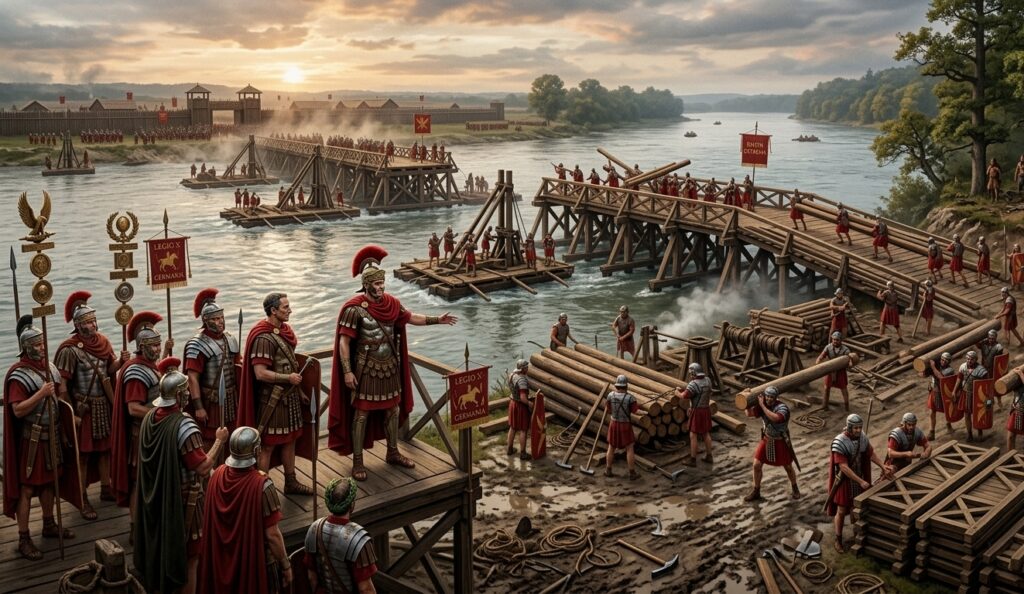
By 55 BCE, Caesar had grown bolder. Germanic tribes across the Rhine were raiding into Gaul. Instead of waiting, Caesar decided to teach them a lesson—Roman style.
In just ten days, his engineers built a colossal wooden bridge across the Rhine River, nearly a thousand feet long. Roman legions marched across, terrifying the Germans. Caesar didn’t linger—after eighteen days, he marched back and dismantled the bridge.
It wasn’t about conquest. It was theater. A flex. A declaration: “No river can stop Rome. And no tribe is safe from me.” It was as much psychological warfare as military maneuver, and it worked.
Crossing the Rhine (55 BCE)
Now, Caesar could have just stayed in Gaul. But he was Caesar. He wanted to send a message to the Germanic tribes across the Rhine: “Don’t mess with me.”
So, he ordered his men to build a bridge across the Rhine River. Not a ferry, not a temporary crossing—an actual bridge, nearly 1,000 feet long, built in ten days. Roman engineering at its finest. He marched his army across, scared the life out of the locals, and—after eighteen days—marched back and dismantled the bridge.
It was pure theater. A flex of military muscle that shouted: “I can go anywhere, anytime.”
The Long Grind: Guerrillas and Scorched Earth
The wars weren’t all dramatic showdowns. Much of Caesar’s campaign was a grind of sieges, ambushes, and clever maneuvering. The Gauls were fierce and resourceful. They used guerrilla tactics, burned crops to starve Roman supplies, and struck quickly before melting into forests.
But Caesar was relentless. He built roads, supply lines, and fortifications faster than the Gauls could burn them. His men marched astonishing distances—sometimes 25 miles a day—striking where least expected. Caesar’s army became a machine: disciplined, flexible, and terrifyingly efficient.
And Caesar himself? He was everywhere: inspecting fortifications, riding into battles, dictating letters at night. His stamina seemed inhuman. His men adored him because he didn’t just command—he endured with them. Cold, hunger, mud, blood—he shared it all.
Britain: Caesar’s Island Adventure (55–54 BCE)
Not content with subduing Gaul, Caesar turned his gaze across the Channel. To the Romans, Britain was a land of mystery—a foggy frontier at the edge of the known world. Traders whispered of tin, slaves, and strange painted warriors, but no Roman army had ever set foot there. For Caesar, the temptation was irresistible. Why stop at Gaul when he could become the man who extended Rome beyond the very limits of the earth?
In 55 BCE, with summer waning, Caesar assembled a modest fleet. His plan was less conquest than reconnaissance: to intimidate, gather intelligence, and impress the people back in Rome with the sheer audacity of the attempt. But even this “small” expedition was unprecedented.
The crossing itself was rough, but the real challenge came at the landing. The Roman ships, heavy and unwieldy, struggled to run aground on Britain’s shallow beaches. The Britons, fighting on home turf, massed along the cliffs and shoreline. Their chariots wheeled across the sand, and javelins rained down on the struggling Romans. Soldiers in full armor hesitated, unwilling to leap into the surf under enemy fire.
Then, in a moment that Caesar himself recorded, a standard-bearer of the famed Tenth Legion leapt forward. Holding his eagle aloft, he cried out:
“Leap, comrades, unless you wish to betray your eagle to the enemy! I, at least, will do my duty to Rome and my general.”
With that, he plunged into the waves. Shamed and inspired, the legionaries followed. One by one they splashed into the water, swords raised, and fought their way ashore. The beach was secured, though at great effort.
Still, Caesar’s first campaign achieved little beyond this symbolic landing. He ventured only a short distance inland before worsening weather and dwindling supplies forced him to withdraw. Yet when news reached Rome, it was packaged as a dazzling triumph. Caesar had invaded a “new world.” Reality mattered less than the story.
The following year, in 54 BCE, Caesar returned determined to do better. This time he brought a far larger force—over 600 ships, 25,000 men, and a determination to make Britain bend. The landing was smoother, and the Britons, awed by the massive fleet, withdrew inland. Caesar pressed forward, encountering fierce resistance but also negotiating with tribal leaders who preferred submission to destruction.
He marched deep enough to overawe the Britons and extract hostages, but once again nature proved a harsher foe than men. Violent storms lashed the Channel, wrecking much of his fleet. The Roman army spent precious weeks repairing ships instead of consolidating gains. Supplies ran low. Though Caesar won several skirmishes, the campaign ended in withdrawal once again.
Militarily, Caesar’s expeditions to Britain were unimpressive—no permanent garrisons, no lasting conquest. Yet politically, they were golden. Caesar returned to Rome as the first Roman general ever to have crossed into Britain. He presented himself as a pioneer, a conqueror who had pushed the boundaries of the known world. Rome was dazzled.
The truth was that Britain would not be brought firmly under Roman rule for nearly a century, until the days of Emperor Claudius. But for Caesar, the appearance of victory was as valuable as the reality. By daring to go where no Roman had gone, he added yet another jewel to his growing legend.
Vercingetorix: The United Gaul
Then came the true test of Caesar’s ambition: a rival unlike any he had faced before. Vercingetorix, the young chieftain of the Arverni, was more than a warrior—he was a visionary. Where others had failed to look beyond their own tribe, he saw the possibility of a single Gallic nation united against the Roman invader. Charismatic, intelligent, and utterly determined, he inspired loyalty in chiefs who had once been bitter enemies. The Gauls, fractured for centuries, finally had a leader who could stand against the legions.
His strategy was radical but effective. Knowing that Rome’s greatest strength was discipline and pitched battle, Vercingetorix refused to give Caesar what he wanted. Instead, he waged a war of attrition: deny food, deny supplies, deny victory. Villages were burned, fields stripped bare, storehouses emptied. The land itself was turned into a weapon. Rome’s legions, so accustomed to feeding off conquered territory, suddenly found themselves hungry and vulnerable.
In 52 BCE, the strategy paid off. At Gergovia, in central Gaul, Caesar launched an overconfident assault on the fortified heights. The Gauls repelled the Romans with ferocious resistance. Legionaries fell in droves, standards were lost, and for the first time in his career Caesar suffered a humiliating defeat. For a moment, the myth of Roman invincibility cracked. Rumors spread that Caesar might lose everything.
But Caesar’s genius was resilience. Where others would retreat, he adapted. He calmed his men, rebuilt alliances with wavering tribes, and plotted his counterstroke. He knew the war would be decided not by one skirmish but by the decisive battle to come. That moment arrived at a place whose name would echo through history: Alesia.
Alesia: Caesar’s Masterpiece
Perched on a hilltop and ringed by rivers, Alesia seemed impregnable. Vercingetorix gathered some 80,000 warriors inside its walls, confident that relief would come. Beyond, another 250,000 Gauls assembled to break the siege. Caesar, with perhaps only 60,000 men, appeared trapped between hammer and anvil.
Yet instead of despair, he answered with engineering genius. His legions built not one wall but two. The inner line, eleven miles long, penned the defenders inside. The outer line, fourteen miles in circumference, bristled with towers, ditches, and deadly traps to repel the relief force. Never before had a general attempted such a feat on this scale. The work was grueling, the pressure immense, but the Romans knew this was their moment of destiny.
When the Gallic reinforcements finally arrived, the world seemed to collapse upon Caesar’s army. Attacks thundered from both directions—sorties from within Alesia, mass charges from without. For days the fighting raged. At one desperate moment, the Roman lines wavered. Caesar, clad in his famous crimson cloak, mounted his horse and rode to the weakest point. His presence transformed panic into courage. The legions counterattacked with iron resolve.
The Gallic coalition broke. Alesia was doomed.
The Gallic coalition broke. The relief army, exhausted and demoralized, melted away into the countryside. Inside Alesia, supplies were gone, hope was gone, and famine gnawed at the defenders. The city was doomed.
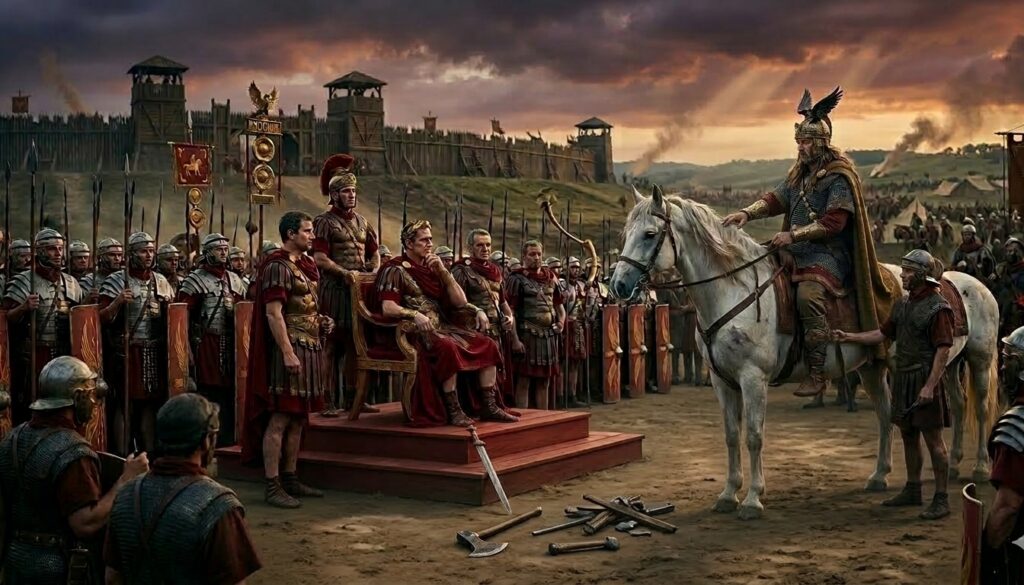
Then came the moment that would be remembered for ages. Vercingetorix, proud even in defeat, refused to flee or bargain. He would face Caesar directly. Clad in full armor, with his crested helmet glinting in the sun, he mounted his warhorse and rode slowly out of the gates. The remaining Gauls, silent and defeated, watched their leader depart.
He entered the Roman camp not as a fugitive but as a king who had lost everything yet retained his dignity. Before thousands of legionaries, Vercingetorix circled Caesar’s command tent in solemn procession, a final gesture of defiance and respect. Then, in deliberate silence, he dismounted. Removing his armor piece by piece, he knelt before Caesar and cast his magnificent sword at the Roman’s feet.
In that gesture, the struggle of a people came to an end. The dream of a united Gaul had been crushed, but the image of its leader surrendering with such stark nobility would echo across centuries. Vercingetorix’s name, though chained and carried to Rome as a prisoner, became immortal—the symbol of a nation’s resistance against empire.
The Legacy of the Gallic Wars
By 50 BCE, Caesar stood supreme. Gaul was his. From the English Channel to the Atlantic coast, Rome now ruled where Celtic tribes had once roamed free. According to Caesar’s own writings, more than a million Gauls were killed or enslaved, though the numbers may have been exaggerated for effect. Still, the scale of conquest was staggering.
The spoils enriched not just Rome, but Caesar personally. His legions, hardened by years of victory, were bound to him with unshakable loyalty. He had made himself indispensable. And he told the story himself—his Commentaries on the Gallic War were written with elegance and precision, painting Caesar as calm, rational, and destined to win. They were propaganda disguised as history.
He was no longer just a general; he was a phenomenon. Every triumph made him larger than life. Every campaign burnished his legend. The Senate in Rome, watching uneasily, realized that Caesar now commanded not only armies but the adoration of the masses. He had become unstoppable—and that terrified them.
As he famously summed up after one lightning campaign:
“Veni, vidi, vici.”
(“I came, I saw, I conquered.”)
And he wasn’t done conquering—not by a long shot.